
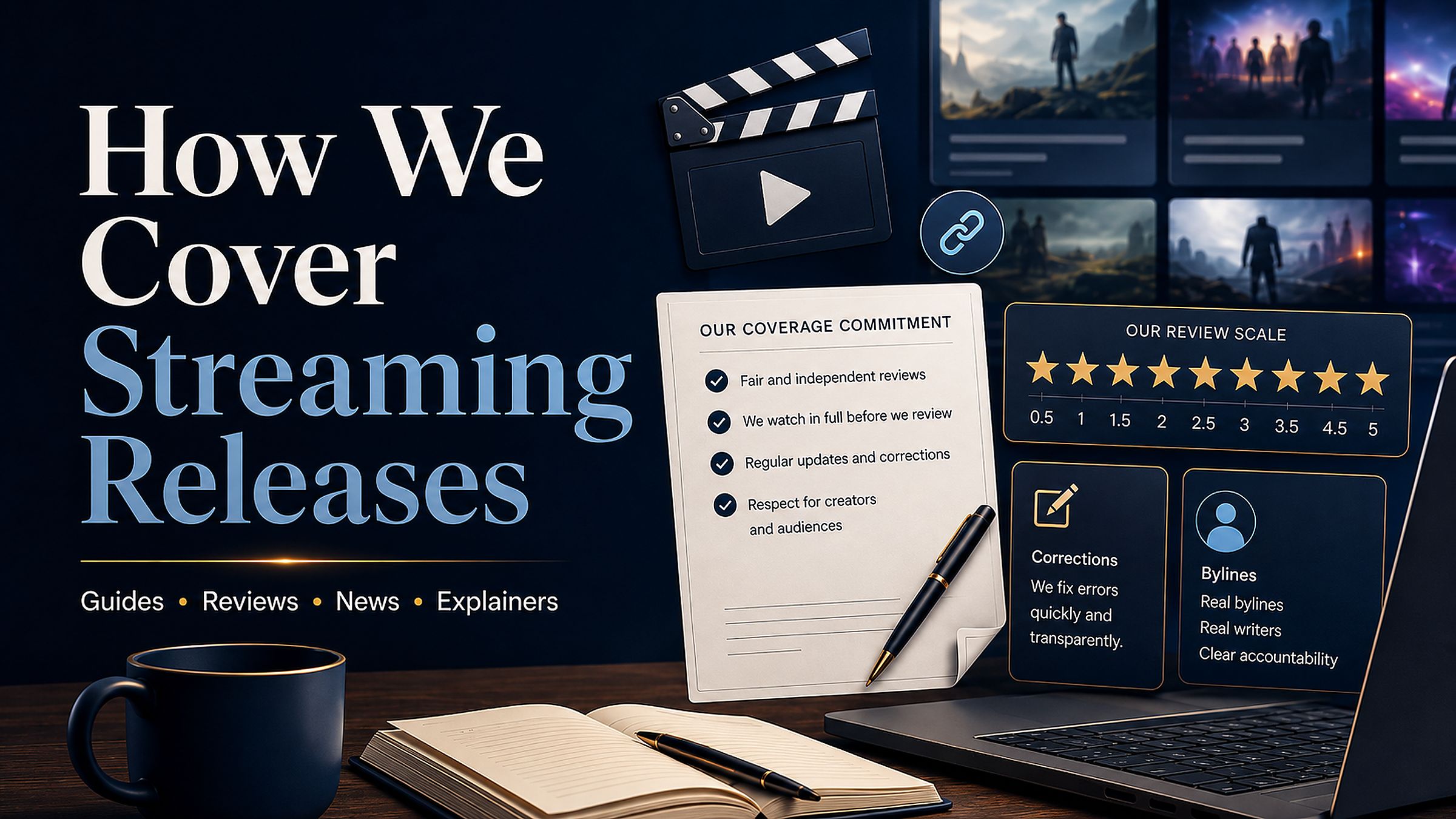
Every publication that writes about films owes its readers an explanation of how it works. What gets covered and what does not. Where the information comes from. What a score actually means. This page is that explanation, and it is the piece we will point to whenever someone asks why a particular film was reviewed or why a rating landed where it did.
What we cover
The focus is streaming releases: films and series arriving on the platforms people in India actually subscribe to, alongside notable international releases that reach the same audience. Language is not a filter. A Telugu drama, a Hindi thriller, a Malayalam procedural and a Hollywood tentpole are all eligible for the same treatment, and the deciding factor is whether readers are likely to be choosing whether to spend an evening on it.
That produces four kinds of article, and each exists for a different reason.
Guides answer a practical question — what has arrived this month, which plan is worth paying for, where a particular title can be watched. These get revisited and updated rather than replaced, because the question stays live even when the answer changes.
Reviews are opinions, written after watching the thing in full. We do not review from trailers, press notes or other people’s coverage.
News covers concrete developments: confirmed streaming dates, renewals, cancellations, casting.
Explainers are for after the credits — endings, timelines, and whether you need to have seen something else first.
How ratings work
Reviews carry a score from 0.5 to 5, in half-point steps. The scale is deliberately coarse. A finer scale invites false precision, and the difference between a 3.4 and a 3.6 is not something anyone can defend honestly.
Roughly: five means it is worth going out of your way for. Four means it is good and you will not regret the evening. Three means it works but has real problems. Two means it does not work but something in it is interesting. One means there is nothing to recommend.
A score is one person’s judgement after one viewing. It is not a measurement, and we would rather you read the reasoning than the number.
Where our links go
Links to watch a title point only to the official page on the platform carrying it — Netflix, Prime Video, JioHotstar, Zee5 and the rest. We do not link to unofficial sources, mirrors, or file hosts, and we do not host any media ourselves.
This is a boundary rather than a preference. A site that routes people to unlicensed copies is participating in the harm, whatever it says about itself elsewhere, and no amount of surrounding editorial makes that acceptable. If a title has no legitimate streaming home in India, we say so plainly rather than finding one.
Images and attribution
Article images are produced in-house rather than reproduced from studio marketing material. Where a still or poster is genuinely necessary to discuss a film, it is used for identification and remains the property of its owner. Our DMCA page sets out how rights holders can raise a concern and what happens when they do.
Corrections
We get things wrong. Release dates move, platforms swap territories, and a detail read at two in the morning turns out to be a detail misread at two in the morning.
When an article is corrected, the correction is made in the article itself and the updated date changes, so you can see that something moved. For anything substantive we say what changed rather than quietly editing. If you spot an error, the fastest route is the address on our contact page, and corrections are treated as higher priority than anything else in the inbox.
Who writes this
Every article carries a byline linking to a real person with a real biography. There are no house names, no invented personas, and nothing published under a generic editorial account. If you want to know who formed an opinion before you weigh it, that information is one click away from every headline.
That principle costs us speed. It is worth it.